Welcome to Reception Class

As your child begins their journey in Reception, this marks a truly special milestone - full of new experiences, friendships and learning opportunities.
We understand this is a time of both excitement and adjustment for families. To help support you through this transition, please see the guidance below with practical tips and reassurance for the weeks ahead.
Your child will grow so much this year - in confidence, independence, and joy of learning. And your support at home makes all the difference.
We are here every step of the way and look forward to working in partnership with you.
Reading
At St Thomas of Canterbury CE Primary School we believe that speaking, listening, reading and writing are fundamental life skills, which enable children to communicate effectively and equip them for the challenges they will face in the wider world.
St Thomas of Canterbury CE Primary School Intent for Reading
At St Thomas of Canterbury CE Primary School we are determined that:
- Every pupil will learn to read, regardless of their background, needs or abilities.
- All pupils, including those who find reading more difficult, will make good progress and are supported to meet age-related expectations.
- Children are able to develop vocabulary, language comprehension, and a love of reading through stories, poems, rhymes and non-fiction texts.
- Children are familiar with, and enjoy listening to, a wide range of stories, poems, rhymes and non-fiction texts.
- Children will read in school daily - this might be in a guided group, 1:1 with an adult or during whole class teaching.
- St Thomas of Canterbury CE Primary School’s phonics programme matches or exceeds the expectations of the national curriculum and the Early Learning Goals.
- St Thomas of Canterbury CE Primary School staff have clear expectations of pupils’ phonics progress term by term, from Reception to Year 2.
- The sequence of reading books shows cumulative progression in phonics knowledge that is matched closely to the school’s phonics programme.
- Teachers will give pupils sufficient practice in reading and re-reading books that match the grapheme-phoneme correspondences they know, both in school and at home. Children will read the same book at least three times in order to build fluency and confidence. They will read the book for the first time with their teacher or TA at school before taking this book home.
- Pre-reading skills such as listening to environmental sounds, developing a love of stories, oral blending and rhyme are taught from the Nursery onwards. We believe children should be exposed to a range of stories and rhymes that become familiar to them (fairy tales, favourite storybooks and nursery rhymes).
- Reading, including the teaching of systematic, synthetic phonics, is taught from the beginning of Reception following our designated phonics scheme.
- Ongoing assessment of pupils’ phonics progress is sufficiently frequent and detailed to identify any pupil who is falling behind the programme’s pace. If they do fall behind, targeted support is given immediately.
- From the time they complete Level 6 phonics, usually during Year 2, children move to Accelerated Reader, which assesses their reading level and provides a ZPD from which children can choose a reading book.
- St Thomas of Canterbury CE Primary School staff have developed sufficient expertise in the teaching of phonics and reading.
Our expectations:
- Children will bring their book bag, reading book and reading diary to school every day.
- Parents will read with their child every night for at least 5–10 minutes and sign and date their reading diary.
- In Reception and Year 1, parents will support children to learn to read high-frequency words – these are sent home with the children regularly.
- From Year 2 – parents will support children to read and spell the words for their year group, which will be sent home at the start of the year.
- In KS2, children can record a sentence in their own book diary about what they have read.
- Children will take good care of books, both at school and at home.
Developing a love of reading
At St Thomas of Canterbury CE Primary School, we have an enthusiastic reading culture and offer lots of exciting opportunities for children to develop a love of reading and stories.
Some of these include:
- Daily class story time where children enjoy listening to a book from our LPS reading spines.
- Close links with our local independent book shop who provide us with up-to-date fiction and non-fiction books for our school library.
- Author visits to inspire our pupils.
- Reading Certificates – during our weekly Celebration Assembly, we celebrate reading and reward children who make excellent effort with their daily reading.
- Reading areas in classrooms – each classroom has an inviting reading area where children can read and share books with friends.
- School Library – we have a range of fiction and non-fiction books that children have access to at all times. School librarians take care of the library, and support younger children to select books appropriately.
Phonics
What is Phonics?
Phonics is a method for teaching the sounds and spelling patterns of the English language; is taught every day, and throughout the day, at school. We recognize that reading is an essential part of a child’s learning journey.
- It is the knowledge of letters and the sounds we make.
- It gives us the skills of blending these sounds together to read words.
- Through phonics, we learn the skills of segmenting the sounds in a word and choosing the correct letters or groups of letters needed to spell it.
- Phonics is the first step to word recognition.
- The ultimate goal for all our children is to be able to automatically read all words, both decodable (words that can be sounded out phonic skills) and common exception words (‘tricky’ words that do not always follow phonic rules).
- Phonics also helps with spelling as they learn how to break up words into sounds and apply these rules to their writing.
How is Phonics taught?
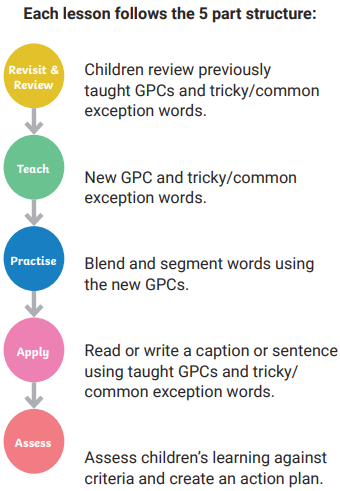 We have a systematic and synthetic approach to the teaching of phonics at Lapford Community Primary School, which engages children in a fun and interactive manner. We use the Twinkl Synthetic Phonics Programme (SSP) which is a DfE approved resource and provides the basis for clear, systematic teaching of the sounds (phonemes) and spelling patterns (graphemes) to support the children’s development in phonics. This is introduced to our children in Pre- School with Level 1 (listening skills and oral blending skills) and is then consistently built upon throughout EYFS (Early Years Foundation stage), Year 1 and Year 2, where children who have met age-related expectations will progress onto Level 6. This unpicks more unfamiliar GPCs and brings more complex spelling rules and grammatical concepts into children’s reading awareness. Children who are still working within the phonics programme will receive extra support to complete their phonics education. Children are assessed regularly, and groupings are altered accordingly if necessary.
The structure of every Twinkl Phonics lesson follows this familiar five-part structure to ensure that the four cornerstones of phonics are covered. During our phonics lessons, children will repeat the elements from the four cornerstones of phonics to ensure that they have rapid and automatic recall of GPCs and tricky/common exception words; each day, they will experience blending and segmenting activities to allow regular practice of these core skills.
The 6 Phonic Levels
There are 48 phonemes (sounds) that the children learn throughout the Twinkl Phonics programme. Children learn these alongside the many graphemes (written variations) for each phoneme:
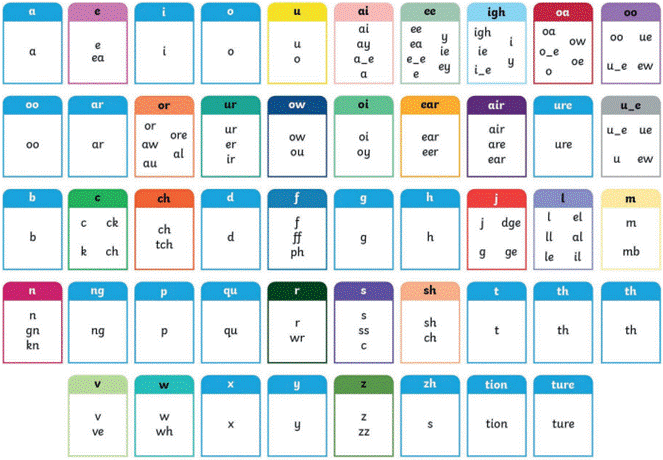
Correct pronunciation of phonemes is very important in helping children read and spell correctly. At St Thomas of Canterbury CE Primary School, we hold parent information sessions at the start of the Reception year to ensure that parents are aware and are using this correct pronunciation. We are also happy to offer support at other times - please just ask!
Once the children learn that sounds also have written meanings, they enter Level 2 of our programme. This begins in Reception. The programme is broken down into this structure:
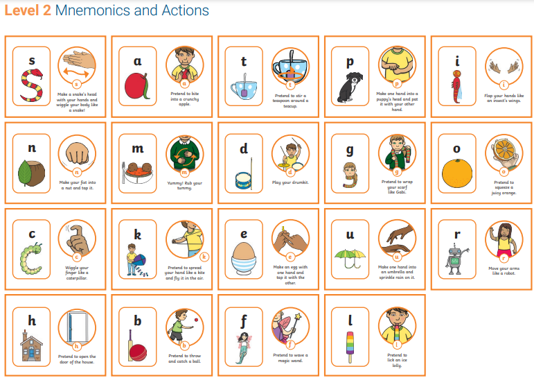
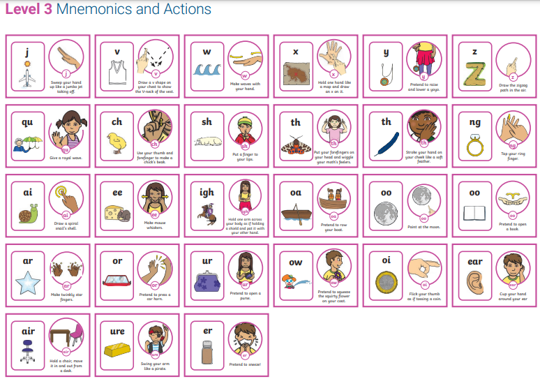
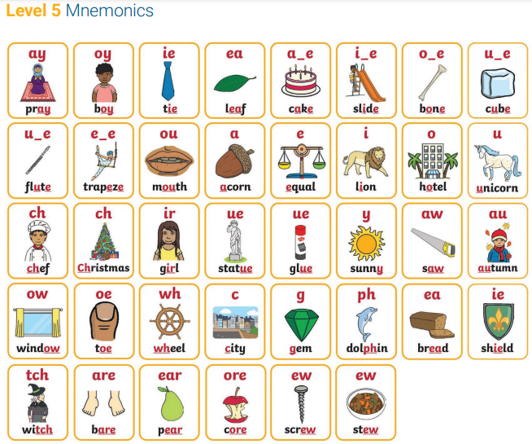
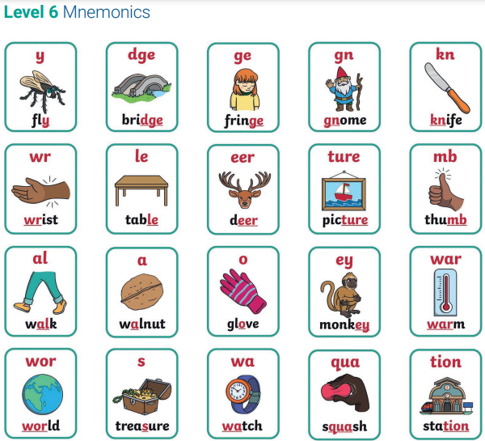
Level 4 is taught at the end of Reception and is used as a consolidation phase to ensure that children are secure on the first 46 GPCs and can apply them to reading longer words fluently. No new GPCs are taught in this level.
High Frequency Words (HFWs)
These are common words that are useful for children to learn to read and spell. As children progress through the levels of Twinkl Phonics, they are introduced to sets of HFWs. These are included in the children’s phonics reading books which are taken home and changed each week.
Some words are decodable which children can blend to read eg. like, with.
Some are tricky words eg. said, which are not phonically decodable and are learned by sight. However, some tricky words do become decodable as children move through the programme eg. when, what.
Inclusion / Intervention
Supporting the Lowest 20% Learners:
Regular assessment is vital to ensure the early identification of children who may need us to provide them with extra support, either through interventions or during daily classroom teaching. Ideally, these children will take part in daily, highly structured interventions, which will normally include recapping or relearning missing GPCs and tricky/common exception words and practising blending and segmenting skills. As soon as we identify any child who is struggling to succeed in phonics, the provision will be put into place to close the gap.
Extending and Challenging Fast Learners:
Regular assessment is also vital to ensuring the early identification of children who may need us to challenge them further, either through extension activities or during daily classroom teaching.
Year 1 Phonics Screening Check:
In the summer term, all children in year 1 will undertake the National Phonics Screening Check. This is an assessment carried out in school during which the children will be assessed on their ability to segment and blend a range of 40 real and ‘alien’ words. Alien words are a selection of phonetically decodable nonsense words. The words in this assessment gauge the children’s understanding of the phonemes learnt and give the school the knowledge of where the gaps are. If the children are not secure in recognising, segmenting and blending these words and therefore do not pass the assessment, they will be offered further support as they enter year 2 and will be able to repeat the assessment in the summer term of year 2. This assessment also allows us to put in specific and personal support for those children who require additional assistance. If a child does not meet the expected standard in year 2, then phonics teaching and learning will be continued into key stage 2. At this point, the child will also be monitored by the SENCo to assess for additional needs.
KS2:
For those children who are working below age-related expectations, phonics learning should not end in KS1. If, through assessment and observation, teachers have decided that a child needs further phonics intervention, Twinkl Codebreakers or Decoders are examples of the interventions that will be used. These are comprehensive and scripted intervention programmes, specifically designed for KS2 pupils to close the gap and develop essential reading and writing skills. Consideration will also be given as to whether these children would be best supported through a Support Plan (see SEND Policy).
Home Learning Expectations
Parental involvement is key in the acquisition of phonics and supports us in developing a cohesive whole-school approach. A phonics workshop for reception parents is held in the autumn term and there are two phonics workshops for year 1 and year 2 parents during the year. During these sessions, we will be sharing information on techniques, such as saying pure sounds and blending. We will also share support resources regularly, such as the parent information sheets, as these can help ensure that parents and carers are using the same strategies at home as the children are learning in school. Phonically decodable reading books are also sent home for parents to support their child’s phonics/reading.
Rhino Readers Decodable Books
Our decodable Rhino Readers reading books make sure children are well prepared to read, containing a ‘before reading’ page which allows children to rehearse the grapheme-phoneme correspondences and tricky/common exception words they will meet in the text. The sound cards match the Twinkl Phonics mats, providing familiarity, and there are also blending practice activities, containing focus words with sound buttons. The ‘after reading’ activities are designed to encourage discussion, recall, sequencing, comprehension and inference at a level appropriate to the text. There are also ‘Rhino Challenges’, with ideas for linked artwork, discussion, drama, craft, investigation - there’s something for everyone to add to the experience and help children make links to their own experiences.